


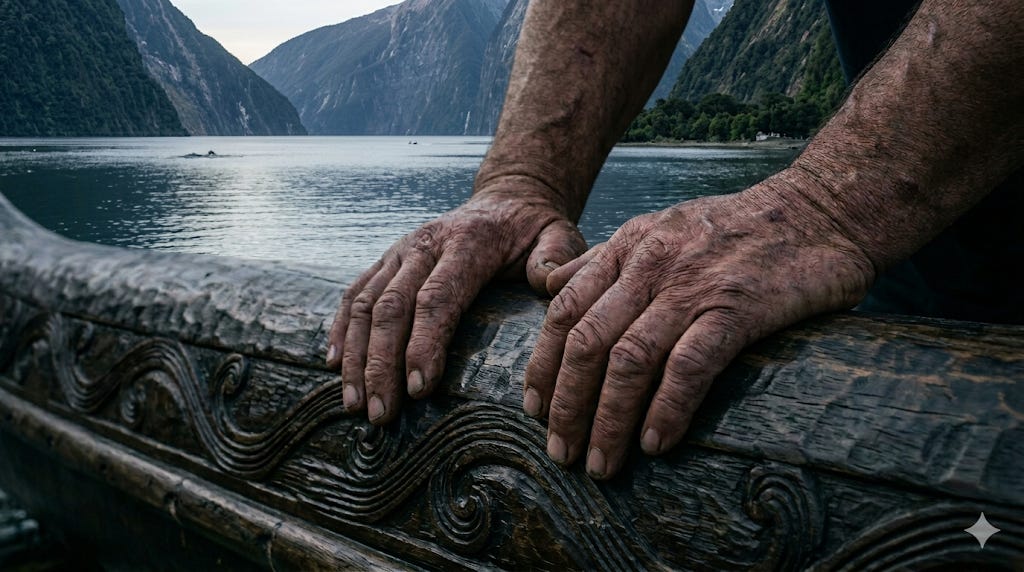
The messenger came in still wet to the knees, salt in the crease of his mouth, and would not sit until he had said the thing he came to say. A whai barb. Broken off under the skin of the meat of the thigh. Six days now. The skin around it had begun to shine.
Tōrea heard him from where he was sitting and did not move. He was working a length of harakeke between his fingers, not because it needed working but because his hands preferred to be doing something while his ears were busy. The fire was low. The room smelled of smoke and of the kelp drying in the rafters and, faintly, of the rain that had passed an hour ago and left the night cold.
Rangi heard the messenger out. She asked him three questions — who, how far gone, what had already been tried — and on the third question the messenger’s voice broke a little and she said, kindly, that he should sit. He sat. Someone gave him kūmara and he ate without tasting.
The room filled. It filled the way it always filled when a decision was coming: the older women first, then a man from the woodpile with bark still on his arms, then a woman from the cooking fires who had not put down the cloth in her hands, then a boy who had simply been walking past and stopped in the doorway and stayed. Not everyone — enough. Hine came in last and sat near the fire and did not say anything.
Rangi worked through it aloud. She was good at this. He had watched her do it for thirty years and it still did something to him — the way she thought with her mouth open, and the room thought with her, and by the time she had said it twice it was almost decided. The canoe in the inlet. Two paddlers, strong ones. Hine and the horopito. Leave at first light, make the run in a day if the weather held, two if it didn’t. The messenger could rest tonight and go back with them in the morning. It was the right shape of an answer. It was the answer anyone in the room would have given.
Tōrea kept working the harakeke. His thumb found a knot and passed over it again.
I’ve learned when to stay quiet. The harder lesson is learning when staying quiet is its own kind of wrong.
His mother had told him once, when he was perhaps eleven, that a man who speaks in a room before he has listened to it is a man who will say a thing he cannot take back. He had taken her at her word and never tested it. He spoke on the water because on the water the water was speaking too and someone had to answer it. In a room there were already enough voices.
But he knew the rock shelf at the mouth of the southern arm. He knew it the way he knew the inside of his own wrist. He had been over it in his father’s waka when he was seven and the old man had told him, look down, boy, look down now, and he had looked down and seen the pale floor of it coming up under them like a hand. He had been over it a hundred times since. He knew what the moon was doing tonight because the moon had been doing it for three nights and tonight was the last of it.
He said her name. Not loud.
“Rangi.”
She looked at him. The room looked at him.
“The shelf at Tūmata’s mouth,” he said. “Spring tide tops tonight. Last night of it. Tomorrow it won’t carry a waka over.”
He said it flat. He was not arguing. He was telling them what was already true.
Rangi held his eye. She did not answer at once. She was thinking, and he watched her think, and the room watched her watch him.
“The fishing,” she said. “Tomorrow’s tide is the new run. We need that catch, Tō. The store is what it is.”
“I know.”
“You’re the one who fishes it.”
“I know.”
“I need twenty minutes,” Hine said from near the fire. “Fresh horopito — for a barb wound it wants a live poultice, pressed before the pulp dries. I’ll gather it now.”
Rangi waited. He let her wait. He was not going to fill the room with reassurance. He had said what he had to say about the water. The rest was hers.
Her head moved — that small tilt, the one he had watched settle over a hundred decisions. The corner of his mouth did what it did. She saw it.
“Within the hour,” she said.
“Within the hour,” he agreed.
That was all of it. The room exhaled. Someone went for the paddlers. Hine stood and lifted the kete and did not look surprised.
Rangi touched his arm as he stood. Not for the room. For him.
=========================================================================
whai — stingray
harakeke — flax
kūmara — sweet potato
horopito — pepper tree; leaves used as a medicinal poultice
kete — woven basket
waka — canoe
Whakahōra — a settlement in the southern fjords