


Vera is my writing coach. She’s a marvel. We were going through a passage together the other day....
The protagonist, Toki is walking home — having just been told his life is about to change. Nothing dramatic on this page. He’s thinking about who to tell.
Vera and I stopped at the same place. I’d missed something in my self-review - not an unusual event. The sentences were fine. That’s the thing I want to write about. Fine and yet wrong, and the wrongness is the kind I read past all the time without catching.
Here’s what I’d written:
He noticed for the first time that day that the sun was shining. He felt the cool breeze coming from the south and slowed his over-brisk walk. He thought about the people he needed to tell. His mother first — she would be proud of him, he was sure of that. And his brother, who would want every detail. And then there was Kate. He found himself wondering whether she would miss him while he was away.
Read it. It parses. It moves. A reader wouldn’t stop.
Here’s where we got to:
He noticed for the first time that day the sun was shining, a cool breeze from the south. He slowed his over-brisk walk and felt the sun on his back. He needed to tell his mother. She would be so proud. And his brother — he’d want every detail. And Kate. Would she miss him?
You can feel the difference before I name it. The second version is inside him. The first is standing next to him, narrating.
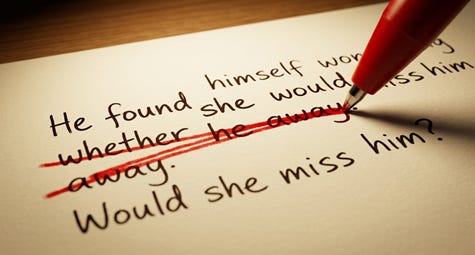
The technique is free indirect discourse — third-person narration that takes the shape of the character’s thoughts without flagging them as thoughts. No he thought. No he found himself wondering. The thought is just there, in his voice, in the prose. She would be so proud. That’s not the narrator’s sentence. That’s his.
Once you see it you can’t unsee it. He felt the cool breeze. He thought about the people. He found himself wondering. Every one of those verbs is a hand on the reader’s shoulder, pointing: look, he is feeling. Look, he is thinking. The reader was already there. The hand on the shoulder is what holds them back.
What makes this difficult to catch in your own work — at least for me — is that the wrong version looks like clarity. Removing he found himself wondering feels like removing a piece of information. It isn’t. The wondering is still on the page. What’s gone is the label.
Vera caught it. I’d read that paragraph many times. The cost of attribution is that it doesn’t look like a cost. When did I start becoming a writing nerd?