

She came every year. The Kura gave her an hour — the same room, the same circle around the low table. Different faces every time.
She set the case on the table and took her time with the clasps.
She opened the case.
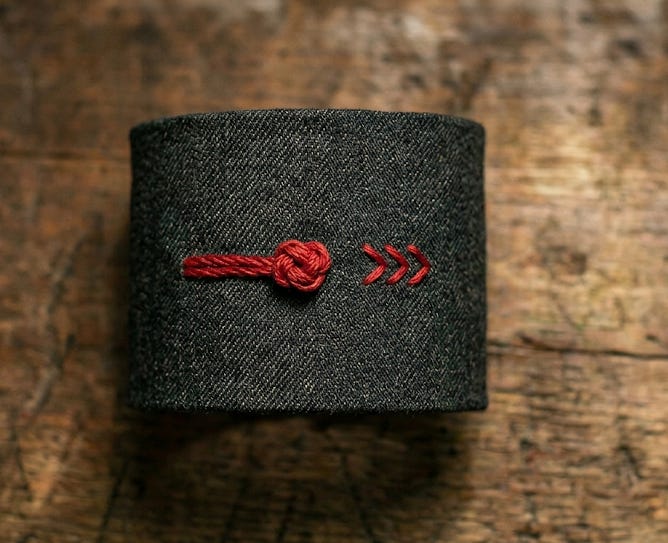
The first band lay in its holder. She lifted it out — dark cloth, broad, a single knot of natural thread. She turned it once in her hands.
One of the younger ones: “Are those yours?”
She paused. Looked at him. Something in the question she found mildly amusing.
“I don’t wear one. I make them. And I remember every eager face at their first knot.”
She let her gaze move around the circle. Then she looked down at their wrists — the plain dark cords, loosely tied, unmarked.
“The cord you each wear has no knots. When your training earns you this, it will have one.”
She ran her thumb along the knot and passed it.
“Tākina.“ She let the word sit. “To summon. To bring forth.”
She watched it travel the circle. The boys were careful with it — more careful than they knew they were being. One turned it over and ran his thumb across the knot as she had.
“The academy, Kurakukū, takes fewer than one in five of you,” she said, while the band moved. “Most of those who make it through will wear this one for ten years.” She waited until it came back, put it in its holder.
The second band. Three knots, and below them a small worked motif in the cloth.
“Māti.“ She turned it so they could see the mark. “To light a fire.” She passed it.
The third: seven knots above a worked geometric pattern — chevron-cut, edged in natural thread. She laid it across her palm before she passed it. It was heavier than the others.
“Whakaute.“ She held her palm level. “Respect. Most careers end here.”
The fourth came out slowly. She held it toward the light.
Seven knots, and above them a small circle with a mark inside it.
“Tohungatanga.“ She tilted it so they could see. “Mastery. It cannot be applied for — three existing tohungatanga must recognise it in you.” She let them look at the mark inside the circle. “That emblem is a different conversation.”
The fifth.
She held it in both hands before passing it. The worked pattern ran edge to edge — no visible beginning, no end. She turned it once, slowly, looking at it herself.
“Kaitiaki.“ She set it in the nearest pair of hands. “Guardian.”
Nothing else. It went around the circle in near-silence.
When it returned she laid it in its holder. Then she reached to the front of the case and drew open the small panel at its base.
She lifted what was inside and did not set it down.
One knot. But the thread was red.
She turned it slowly in her hands, rotating it toward each section of the circle in turn. Let them see the knot. Let them see the colour.
“What is this?” she said.
Hands went up. Not all. Not the boy slightly off to one side — he’d been watching the case more than the others. His hands stayed in his lap.
She nodded at a boy across the circle.
“The Tūmua‘s band.” He said it with satisfaction. “One knot — but red.”
“Yes.” She held it up. “The Order’s only position of formal authority. One knot — the same count as your first.”
Hisaki was the first — appointed in the year the empire absorbed the Order. Maretō Nari held it longest — forty-one years; the one who rebuilt the deposit protocols after the Whare Mahara collapsed. Natoku Sene held it for barely a season — some people did not count him, because of the circumstances, but he was in the record.
“And Ishito Naru.” She paused. “He is buried at Shùlín xià.”
A voice from across the circle. Quiet. Not raised.
“Loko lua pele.”
She looked. The boy off to one side. Hands in his lap. Eyes on the table.
“He wasn’t at Shùlín xià,” he said, without looking up. “He was at Loko lua pele when he died. He wasn’t assigned there.”
The room was still.
“No,” she said. “He was not.”
He looked up — a quick glance, as if checking whether he’d been allowed to say it. Then back down.
“Why was he there?” A pause. “The deposit at Shùlín xià wasn’t complete. He would have stayed to finish it — that’s what the record says. But Loko lua pele isn’t Shùlín xià.”
She looked at him steadily. He was not performing. He was asking.
“You already know part of the answer,” she said.
He was quiet a moment. “The obligation runs until the deposit is complete,” he said. “He would have stayed wherever the work was.” A half-glance up. “I wondered if he was asked to go.”
She put the red band back in its panel and closed it.
“What’s your name?” she said.
His head came up. The colour went into his face — the look of a boy who thinks he’s crossed a line he couldn’t see. He looked at his hands.
Then he looked up.
“Toki,” he said. “Narako Toki.” The slightest straightening. Not much. Enough.
She nodded and moved on.
She closed the case at the end of the hour and carried it out through the yard alone.
She’d tie his eventually. She already knew the name.
——————————————————-
Hinerau Peka has been the Tataupona for thirty-one years
Kura — (noun) school, academy; treasure, precious thing; red